

Why Queenslander Stairs Need Specialist Care
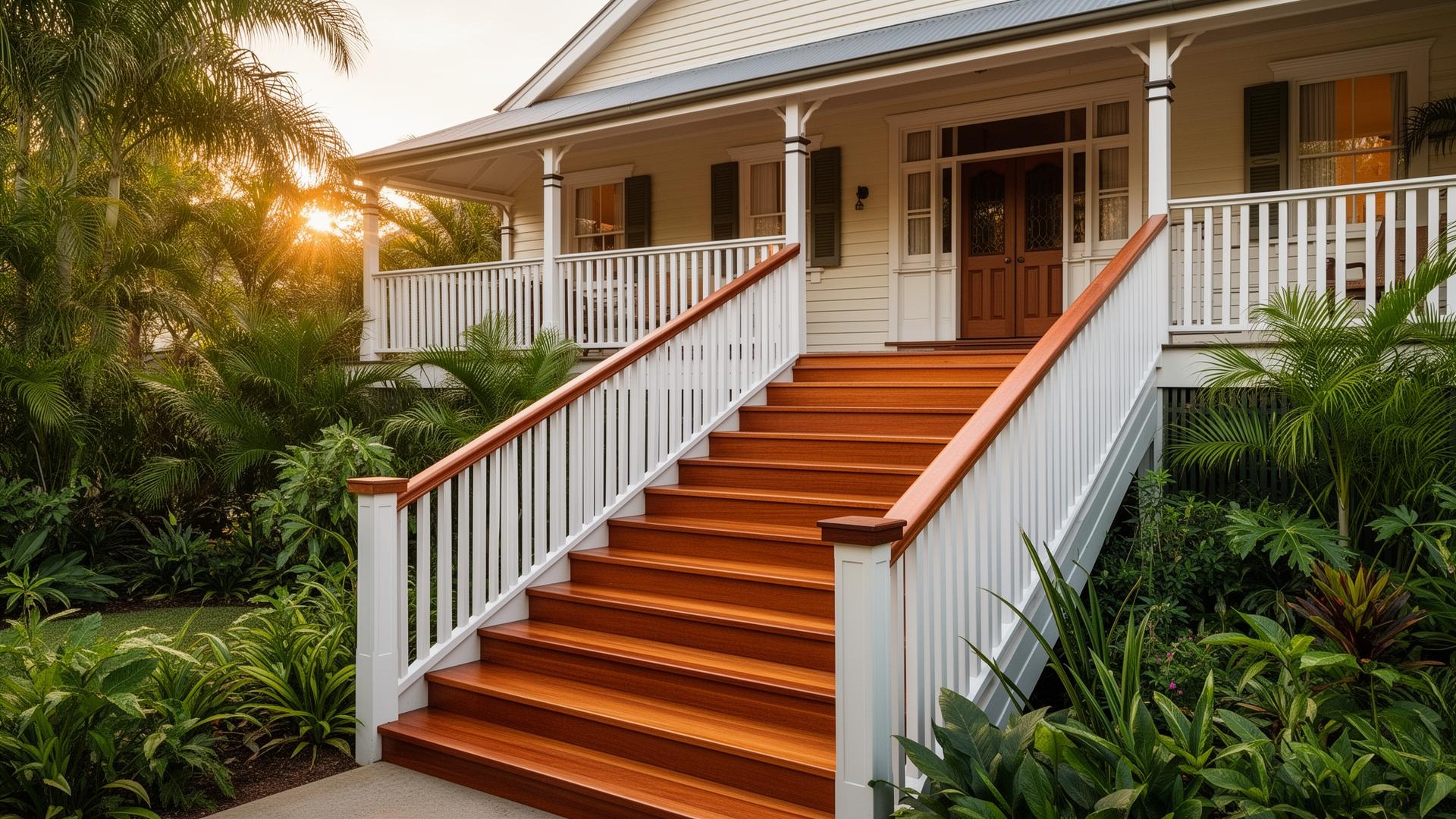
Queenslander stairs aren't just decorative. They lift the home for airflow, manage flood risk and frame the verandah — the heart of the home. That heritage character is exactly why a generic rebuild often looks wrong.
Original stringers, treads and balustrades were typically cut from old-growth hardwoods (silky oak, hoop pine, red cedar) that are no longer commercially available. A sympathetic restoration matches profiles, joinery details and proportions — not just dimensions.
Anatomy of a Queenslander External Stair
Before quoting a restoration, we map every component. Some can be saved with epoxy and a sand-back. Others must be replaced for safety.
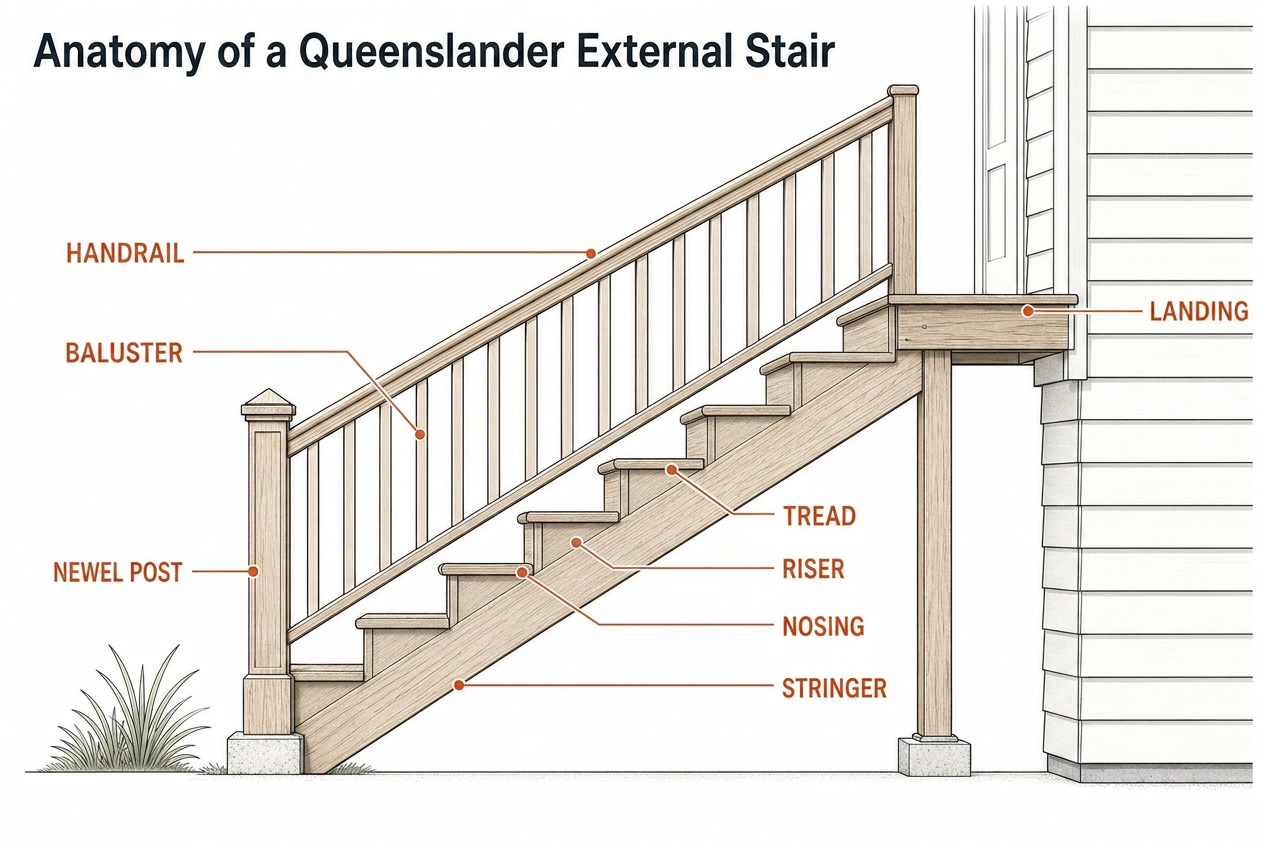
- Treads — the part you step on. Hardwood, typically 32–45 mm thick.
- Risers — the vertical board between treads. Often missing on traditional Queenslanders.
- Stringers — the diagonal sides supporting treads. Critical structural element.
- Balustrade — the row of balusters. Heritage homes used turned timber or simple square pickets.
- Handrail — must sit ≥865 mm above the nosing line under the National Construction Code.
- Newel posts — the chunky corner posts. The most visible heritage feature.
Common Faults We Find on Brisbane Queenslanders
Most original external stairs we inspect have at least two of the issues below. The good news? Few jobs need a full demolition.
Rot at the Bottom of the Stringers
The base of each stringer sits closest to wet soil and is the first part to fail. We commonly see soft, dark timber that crumbles under a screwdriver tip. Replacement of the bottom 300–500 mm is a standard repair.
Termite Damage
Subterranean termites love untreated hardwood in shaded, damp conditions. If you suspect activity, organise a termite damage inspection before any timber work begins.
Non-Compliant Balustrades
Original picket gaps were often 150–200 mm. Modern code caps gaps at 125 mm to stop small children passing through. Replacement or infill is almost always required during restoration.
Loose or Low Handrails
Heritage handrails frequently sit below the modern 865 mm minimum measured from the nosing pitch line. A discreet timber packing piece or full replacement brings them up to code without losing character.
Our Heritage-Sensitive Restoration Process
Here's how a typical Queenslander stair restoration unfolds when you engage a QBCC-licenced carpenter for the work. See the National Construction Code for the underlying safety requirements.
- 01Heritage assessment — photograph existing profiles, document any council overlays.
- 02Structural sounding — probe every stringer, tread and post for rot, splits and termite voids.
- 03Salvage plan — mark what can be repaired in-situ vs replaced.
- 04Like-for-like timber selection — match the species, grain and finish (usually spotted gum, blackbutt or recycled hardwood).
- 05Bring to code — close baluster gaps to ≤125 mm, lift handrail to ≥865 mm, add ≥1 m balustrade where the drop exceeds 1 m.
- 06Re-coat — two coats of marine-grade oil or decking stain for South-East Queensland climate.
- 07Handover — written records of any compliance upgrades for resale.
What Determines the Cost of Queenslander Stair Restoration?
Scope varies widely with the level of damage and the finish you choose. In rough order of size, most Brisbane jobs fall into one of three levels.
Light cosmetic refresh — sand, fill, re-coat and tighten the balustrade. The smallest scope, suitable where the structure is sound.
Mid-range restoration — replace a handful of treads, bring the balustrade up to code and re-coat. The most common outcome.
Full rebuild with heritage profiles — new stringers, treads, turned balusters and a hardwood handrail, plus footings and approvals. The largest scope by a wide margin.
For a full breakdown of the factors that move the number, see our guide to what determines the cost of external stairs in Brisbane.
Ready to Restore Your Queenslander Stairs?
Carpentry Worx specialises in heritage-sensitive external timber work across Brisbane North, Moreton Bay and the Sunshine Coast. We're QBCC licenced, insured and happy to walk you through the trade-offs before you commit. Browse our full external stairs service page or get in touch for a quote.
Need a Hand From a Brisbane & Sunshine Coast Carpenter?
Carpentry Worx is QBCC licenced and servicing Brisbane North, Moreton Bay and the Sunshine Coast. Get a quote on your project today.
Useful Links
Related Articles
- External StairsOutdoor Timber Stairs: The Brisbane Material GuideWhich timber survives Brisbane's hot, wet, humid climate — and which one falls apart in five years? A working carpenter's honest comparison.Read article
- External StairsTimber Stair Treads: The Complete Buying GuideStandard sizes, species, profiles and prices — everything you need to know before ordering timber stair treads for your Brisbane build.Read article
- External StairsWhat Determines the Cost of External Stairs in Brisbane?A working carpenter's guide to what drives external stair costs in Brisbane — the specification choices that matter, where you can save, and what a fair quote looks like.Read article
- External StairsStair Balustrade Regulations in Queensland — Plain EnglishConfused by 865 mm, 1000 mm and 125 mm? Here's exactly what the National Construction Code requires for stair balustrades in Queensland — and where homeowners trip up.Read article